What Is AI SEO? The Complete 2026 Guide to AEO, GEO, and LLM Search
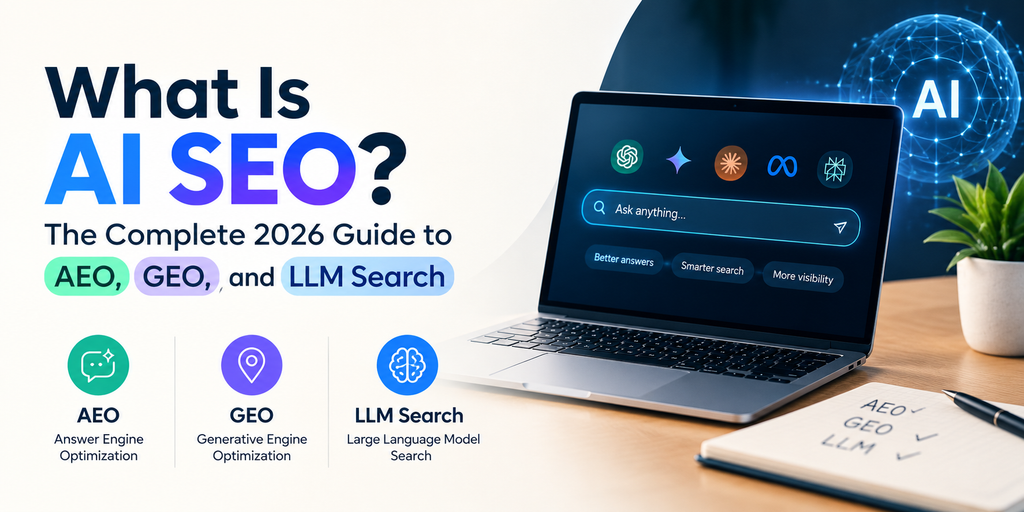
What Is AI SEO? Easy 2026 Guide to AEO and GEO
Remember when ranking online was simple? You picked a keyword, dropped it into your title tag, sprinkled it across a 1,500-word blog post, built a few backlinks, and waited for Google’s ten blue links to send you organic traffic.
Search is no longer a list of links. It is a live conversation.
People type complex, multi-sentence prompts directly into ChatGPT, Perplexity, Claude, and Google Gemini. Instead of browsing three different websites to compare answers, users get an accurate, synthesised summary directly on screen.
If your website isn’t cited inside those AI answers, your organic visibility drops significantly.
Understanding what is AI SEO—and its two primary pillars, AEO and GEO—is essential for capturing search traffic in 2026. This complete, beginner-friendly guide breaks down how modern retrieval models work, how they evaluate content, and how you can earn citations across search engines and AI assistants.
What Is AI SEO? The New Search Reality
AI SEO is the practice of optimizing your digital content so that artificial intelligence systems, large language models (LLMs), and AI-driven search engines can discover, understand, trust, and cite your brand in their answers.
Traditional SEO focuses on helping search bots index web pages to rank in search results. AI SEO goes further: it structures your content so AI assistants use your work as an authoritative reference.
Traditional Search:
User Query ──> Search Engine Index ──> 10 Blue Links ──> User Clicks

AI Search:
User Query ──> Web Retrieval (RAG) ──> AI Synthesis ──> Answer with Citations
Rather than hunting for clicks across dozens of pages, users rely on models that synthesize information using Retrieval-Augmented Generation (RAG). In a RAG pipeline, the AI combs the web in real time for credible sources, summarizes the best information, and credits the most authoritative publishers.
What Is AEO? (Answer Engine Optimization)
AEO (Answer Engine Optimization) focuses on structuring your content to deliver direct, concise answers to specific user questions.
Answer engines include:
- Google featured snippets and “People Also Ask” cards
- Voice search assistants like Siri and Google Assistant
- Direct-answer interfaces on engines like DuckDuckGo and Bing
AEO operates on an answer-first principle. If a reader asks, “What temperature should brisket be wrapped at?”, an AEO-optimized post does not open with a 500-word narrative about summer barbecues. It delivers the answer in sentence one: “Brisket should be wrapped between 165°F and 170°F when the bark has set.”
What Is GEO SEO? (Generative Engine Optimization)
GEO (Generative Engine Optimization), often called GEO SEO, prepares your content to be cited, summarized, and recommended by generative AI engines like ChatGPT, Claude, Perplexity, and Google Gemini.
While AEO targets single facts or direct answers, GEO targets broader queries:
- “Compare the top five warehouse management tools for mid-market retail.”
- “What are the risks of using lithium iron phosphate batteries in marine setups?”
GEO ensures your brand, unique data, and case studies are integrated into synthesized answers across AI models.
Comparing the Approaches: AI SEO vs SEO, AEO, and GEO
The search landscape spans three distinct disciplines. Here is how traditional search, answer-first formatting, and generative visibility work together:
| Dimension | Traditional SEO | AEO (Answer Engine Opt.) | GEO (Generative Engine Opt.) |
| Primary Destination | Google, Bing blue links | Featured snippets, Voice search | ChatGPT, Perplexity, Gemini |
| Target Goal | Rank on Page 1 for high CTR | Win the single zero-click snippet | Earn citations and brand mentions |
| Content Structure | Keyword-dense, comprehensive articles | Snappy definitions, Q&A blocks, tables | Data-rich insights, original research |
| Core Metric | Organic rankings and raw traffic | Impressions and snippet ownership | Referral traffic, citation frequency |
These are not competing strategies—GEO and AEO build directly on the technical base established by traditional SEO.
The Core Pillars of LLM SEO
To get indexed by large language models (a field known as LLM SEO), you need to format your content around how language models process information:
┌────────────────────────────────────────────────────────┐
│                   THE LLM SEO TRIANGLE                 │
│                                                        │
│                  Information Gain                      │
│             (Original Data & Research)                 │
│                        ▲                               │
│                       / \                              │
│                      /   \                             │
│                     /     \                            │
│                    ▼       ▼                           │
│     Entity Clarity   ◄───►  Clean Formatting           │
│  (Schema, Clear Bio)       (H2s, Lists, Data Tables)   │
└────────────────────────────────────────────────────────┘
1. Information Gain
LLMs filter out repetitive web copy. If your post says the same thing as the top ten search results, an AI summarizer has no reason to cite your site over another. You need information gain: proprietary survey results, firsthand experiments, direct case studies, or counter-intuitive insights.
2. Entity Disambiguation
AI models think in entities (real-world people, organizations, concepts, and places), not isolated keywords. Use structured Schema markup (Organization, Author, sameAs) so bots know who you are and can connect your insights to your brand.
3. Clear Hierarchy
Clean HTML headings, markdown tables, and short paragraphs give algorithms clear reference points. The easier it is for a bot to parse a self-contained concept, the easier it is to lift that fact into a cited summary.
Tactics for Specific Platforms
Different platforms rely on different discovery systems. Optimizing for Google looks different than earning citations in Perplexity or ChatGPT.
AI Overviews Optimization: Winning Inside Google
Google’s AI Overviews display synthesized summaries above traditional organic search results.
┌──────────────────────────────────────────────────────────┐
│  Google Search Query: "best workflow automation 2026"     │
├──────────────────────────────────────────────────────────┤
│  ✨ AI Overview                                          │
│  To automate cross-tool tasks, modern teams rely on...   │
│  • Tool A: Best for developer-centric webhooks           │
│  • Tool B: Best for no-code enterprise routing           │
│                                                          │
│  Sources:  [YourBrand.com]  [IndustrySite.org]          │
└──────────────────────────────────────────────────────────┘
To optimize for AI Overviews:
- Target conversational, long-tail questions: Queries with four or more words frequently trigger AI Overviews.
- Answer above the fold: Open each section with an explicit 40-to-60-word answer before expanding into nuances.
- Retain traditional SEO best practices: Pages cited in AI Overviews generally rank on Google’s first page for related search terms.
How to Rank in ChatGPT
ChatGPT searches the web using Bing and dedicated search pipelines, but it also draws on its underlying training data.
To improve your visibility in ChatGPT:
- Build authority on external platforms: ChatGPT references reviews, third-party roundups, Wikipedia entries, and Reddit threads. If your brand only exists on your own blog, the model may overlook it.
- Publish clear definitions: Write definitive explanations of key concepts across your industry.
- Keep technical bots unblocked: Ensure your
robots.txtfile does not blockOAI-SearchBotor common search crawlers.
How to Get Cited by Perplexity
Perplexity acts as an answer engine paired with live citations. It evaluates real-time sources to back up its responses with footnoted links.
To earn Perplexity citations:
- Add structured data tables: Perplexity regularly pulls information from structured comparison tables and price breakdowns.
- Update your content regularly: Perplexity emphasizes fresh content. Include visible timestamps (“Last updated: October 2026”) and refresh older data points.
- Write factual, neutral headlines: Avoid vague, clickbait titles. Use clear questions that match how people talk: “How does solar battery storage handle cold weather?”
Building a 2026 AI SEO Strategy
Here is a 5-step framework to transition your site from basic keyword targeting to an AI-ready resource:
[1. Map Question-Based Queries]
              │
              ▼
[2. Front-Load Clear Answers]
              │
              ▼
[3. Add Original Data & Benchmarks]
              │
              ▼
[4. Implement Schema Markup]
              │
              ▼
[5. Track AI Referrals & Citations]
Step 1: Map Questions to High-Intent Needs
Move beyond single target terms. Run customer interviews, review support tickets, and check forums to identify the exact questions buyers ask before purchasing.
Step 2: Structure Every Page with Inverted Pyramid Style
Open articles with the core takeaway.Follow with practical applications, examples, and edge cases.This layout serves busy human readers and makes it easy for AI scrapers to extract accurate information.
Step 3: Publish Primary Data
Run an annual industry poll, analyze anonymized user trends, or test five products side-by-side. Original statistics give models a definitive reason to cite your research.
Step 4: Add Structured Schema Markup
Use JSON-LD schema across your site. Add FAQPage, Article, HowTo, and Product tags so AI bots can parse your claims, prices, and specifications accurately.
Step 5: Monitor AI Citations
Track your traffic sources in Google Analytics 4 for referrals from chatgpt.com, perplexity.ai, and gemini.google.com. You can also run regular branded prompt checks inside AI engines to see where and how your company is cited.
Actionable AEO Checklist for Your Content
Before hitting publish on your next article, run through this practical checklist:
- [ ] Direct Lead: Does the first section answer the primary query within two sentences?
- [ ] Clear Headings: Are your H2s and H3s written as clear, scannable phrases rather than abstract puns?
- [ ] Scannable Elements: Have you included at least one markdown table, numbered sequence, or bulleted list?
- [ ] Information Gain:Does the post share a unique perspective, proprietary data point, or personal case study?
- [ ] Structured Markup: Is appropriate Schema applied to identify the author and page structure?
- [ ] Entity Consistency:Are your brand name, pricing, and product details identical across your site and third-party profiles?
- [ ] Freshness Signals: Is the publish or update date displayed clearly at the top of the post?
The Road Ahead: Why Authority Always Wins
AI search engines change their algorithms regularly, but their underlying objective remains the same: deliver accurate, trustworthy answers to human users.
SEO is not dying; it is evolving.By delivering direct answers (AEO), structuring unique data for generative models (GEO), and showing real-world expertise, you can protect your search visibility and ensure your brand gets cited across the web.
Shashi Saivi - Digital Marketing ConsultantPhone: +918618112263