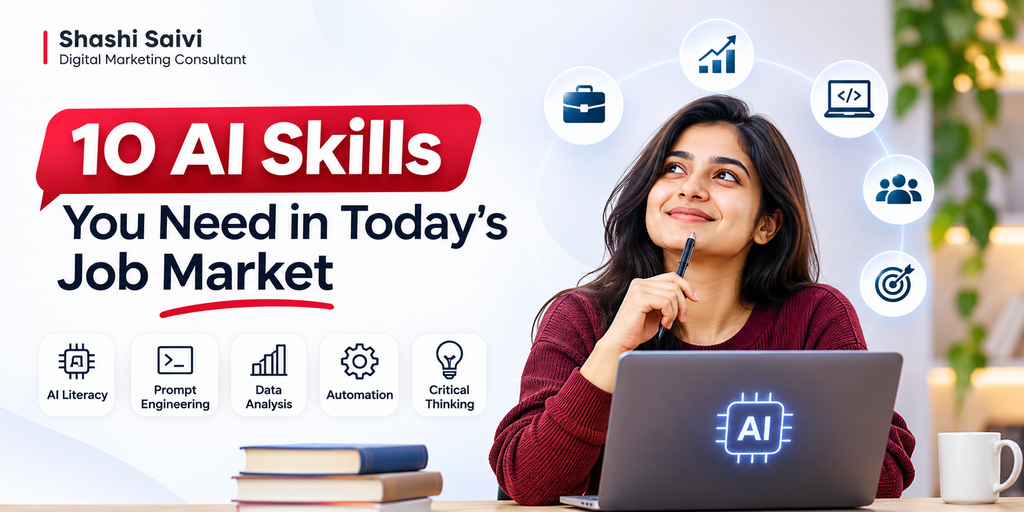
AI Skill You Need in 2027: What You Need to Know
1. AI Literacy: Understand How Artificial Intelligence Works
Many readers ask about AI Skill you need in 2027 – here are the key facts, explained simply.
AI literacy is becoming a basic professional skill, much like computer literacy was in earlier years. It means understanding what artificial intelligence can do, how AI-powered applications work, and where their limitations exist.
You don’t need to understand complex algorithms to develop AI literacy. However, you should know the difference between machine learning, generative AI, automation, and large language models.
For example, a marketing professional should understand how AI can help with customer segmentation, campaign research, and content analysis. Similarly, an HR professional should understand how AI can assist with recruitment workflows and candidate screening.
What you should learn:
-
- Fundamentals of artificial intelligence
-
- Machine learning basics
-
- Generative AI concepts
-
- Large language models (LLMs)
-
- Practical applications of AI in your industry
Useful tools: ChatGPT, Google Gemini, Microsoft Copilot.
2. Prompt Engineering: Learn How to Communicate with AI
Using an AI tool is easy. Getting consistently useful results from it requires a different skill.
Prompt engineering is the process of writing clear instructions and providing relevant context to get more accurate and useful outputs from AI systems.
Consider two examples.
A basic prompt: “Write a blog about digital marketing.”
A more effective prompt: “Write a 1,500-word SEO-friendly blog for Indian small business owners explaining how Google Ads can generate qualified leads. Include practical examples, keyword variations, FAQs, and a conversational professional tone.”
The second prompt gives the AI a clear objective, audience, context, and expected output.
This skill is useful across marketing, sales, content creation, research, customer support, and business operations.
What you should learn:
-
- Writing structured prompts
-
- Providing context and instructions
-
- Using examples to guide AI responses
-
- Breaking complex tasks into smaller instructions
-
- Evaluating and refining AI-generated results
Useful tools: ChatGPT, Claude, Google Gemini, Microsoft Copilot.
3. Data Analysis and Interpretation
Businesses collect enormous amounts of information, but data becomes valuable only when someone can interpret it and make meaningful decisions.
AI can help analyse spreadsheets, identify patterns, summarise reports, and generate insights. However, professionals still need to understand whether those insights are relevant and accurate.
For example, an eCommerce business might use AI-assisted analysis to understand which products generate the highest revenue, which campaigns have increasing acquisition costs, and where customers are dropping out of the buying journey.
Learning data analysis can make you valuable across multiple industries.
What you should learn:
-
- Microsoft Excel and Google Sheets
-
- SQL fundamentals
-
- Data visualisation
-
- Understanding KPIs and business metrics
-
- Basic statistics
-
- Interpreting AI-generated reports
Useful tools: Microsoft Excel, Power BI, Tableau, Google Looker Studio, ChatGPT.
4. Critical Thinking and Problem-Solving
AI can generate answers within seconds, but that doesn’t mean every answer is correct.
One of the most important skills in today’s workplace is the ability to question information, identify mistakes, evaluate alternatives, and make decisions based on evidence.
Imagine asking an AI tool to analyse a company’s declining sales. It might suggest increasing advertising budgets, changing prices, or improving customer retention.
But which recommendation should the company actually implement?
That depends on understanding the business, examining the available data, and identifying the real problem.
AI can support the decision-making process, but human judgement remains essential.
What you should learn:
-
- Evaluating information critically
-
- Identifying inaccurate AI outputs
-
- Root-cause analysis
-
- Logical reasoning
-
- Decision-making
-
- Comparing multiple solutions
This skill is particularly important for managers, analysts, consultants, and business professionals.
5. AI Automation and Workflow Management
Businesses are constantly looking for ways to reduce repetitive work and improve operational efficiency.
AI automation helps connect different applications and automate tasks that previously required manual effort.
For example, imagine receiving a customer enquiry through a website. An automated workflow could capture the enquiry, categorise it, update the CRM, generate a notification for the sales team, and initiate a personalised follow-up.
This is where AI automation skills become valuable.
You don’t necessarily need advanced programming knowledge to start building simple workflows. Several no-code and low-code platforms make automation accessible to non-technical professionals.
What you should learn:
-
- Workflow design
-
- Process automation
-
- API fundamentals
-
- CRM integration
-
- No-code and low-code automation
-
- AI-powered agents and workflows
Useful tools: n8n, Zapier, Make, Microsoft Power Automate.
6. Programming and Technical Understanding
If you want to build a technical career in artificial intelligence, programming is an important skill to develop.
Python is particularly popular in AI and machine learning because of its extensive libraries and developer ecosystem.
Understanding programming also helps professionals work with APIs, connect applications, process information, and build customised AI solutions.
However, the depth of programming knowledge required depends on your career direction. An AI engineer needs a much stronger technical foundation than someone using AI for marketing or business operations.
What you should learn:
-
- Python programming
-
- Basic data structures
-
- SQL
-
- API integration
-
- Machine learning fundamentals
-
- Git and version control
Useful tools: Python, Jupyter Notebook, Google Colab, GitHub, TensorFlow, PyTorch.
7. Communication and Content Creation
Technology may change the way we work, but communication remains central to almost every profession.
AI can help draft emails, prepare presentations, summarise meetings, and create content. However, professionals must still know how to communicate ideas clearly, understand their audience, and deliver messages that make sense.
For example, a business analyst might use AI to summarise a complex report. But explaining its findings to a management team requires communication skills and an understanding of business priorities.
Similarly, marketers need to ensure that AI-generated content reflects the brand’s personality and addresses actual customer needs.
What you should learn:
-
- Professional writing
-
- Business communication
-
- Presentation skills
-
- Storytelling
-
- Content strategy
-
- Editing and fact-checking
Useful tools: Grammarly, ChatGPT, Canva, Microsoft PowerPoint, Google Workspace.
8. Creativity and Innovation
AI can generate hundreds of ideas, designs, headlines, and content variations. But creating something genuinely useful requires more than generating multiple options.
Creativity involves understanding problems from different perspectives, identifying opportunities, and developing ideas that provide value.
For example, a marketing professional can use AI to generate campaign concepts, but deciding which concept connects with the target audience requires creative thinking and market understanding.
Similarly, entrepreneurs can use AI to research business opportunities, explore product ideas, and test different approaches.
The real advantage comes from combining human creativity with AI’s ability to process information quickly.
What you should learn:
-
- Creative problem-solving
-
- Design thinking
-
- Experimentation
-
- Idea development
-
- Innovation management
-
- Understanding customer behaviour
9. AI Ethics, Data Privacy and Responsible AI Usage
Using AI responsibly is becoming an important professional requirement.
AI systems can produce inaccurate information, reflect biases in their training data, or expose confidential information if used carelessly.
Professionals should understand what information can be shared with AI tools, how personal data should be protected, and why important decisions require human oversight.
For example, uploading confidential customer information or company financial records into an unauthorised AI application could create serious privacy and security risks.
Responsible AI usage is not limited to technical professionals. It matters to marketers, HR teams, consultants, analysts, managers, and business owners.
What you should learn:
-
- Data privacy fundamentals
-
- Responsible AI practices
-
- Understanding AI bias
-
- Information verification
-
- Copyright awareness
-
- Secure handling of business information
10. Adaptability and Continuous Learning
Perhaps the most important skill is the willingness to keep learning.
AI technologies are evolving rapidly. Tools that are popular today may become less relevant as better solutions emerge. New platforms, applications, and working methods will continue to change professional expectations.
Instead of learning one tool and depending on it forever, develop the ability to understand new technologies and apply them to your work.
For example, a digital marketer should not limit their knowledge to one AI writing application. They should understand how AI can support research, advertising, analytics, creative development, and automation.
The same principle applies to developers, designers, HR professionals, and business managers.
What you should learn:
-
- Learning new technologies
-
- Staying updated with industry developments
-
- Experimenting with AI applications
-
- Improving existing professional skills
-
- Adapting to changing business requirements
Continuous learning is not a one-time activity. It is an ongoing investment in your career.
Which AI Skills Should You Learn First?
You don’t need to learn all ten skills simultaneously. Your starting point should depend on your educational background, professional experience, and career goals.
| Your background | Recommended skills to start with |
|---|---|
| Students and freshers | AI literacy, prompt engineering, data analysis |
| Digital marketers | Prompt engineering, automation, data analysis |
| Software developers | Python, machine learning, APIs |
| HR professionals | AI literacy, automation, data privacy |
| Business professionals | Data analysis, problem-solving, AI automation |
| Content creators | Prompt engineering, communication, creativity |
| Managers and team leaders | AI literacy, decision-making, responsible AI |
The best approach is to select two or three relevant skills, practise them through real projects, and gradually expand your knowledge.
How to Build AI Skills Without Spending Too Much Money
Learning artificial intelligence doesn’t always require an expensive course or a specialised degree.
There are several platforms where you can start developing practical knowledge.
1. Google Cloud Skills Boost: Explore introductory learning paths related to AI, machine learning, and cloud technologies.
2. Microsoft Learn: Learn about generative AI, Azure AI services, and practical applications of AI.
3. IBM SkillsBuild: Explore free educational resources covering AI fundamentals and emerging technology skills.
4. Kaggle: Practise data analysis, Python, and machine learning using real datasets.
5. YouTube: Follow practical tutorials and build projects instead of only watching theoretical explanations.
6. AI tools: Experiment with ChatGPT, Gemini, and other applications to understand how AI can solve everyday professional problems.
One important suggestion: don’t collect certificates just to add them to your resume. Build projects that demonstrate what you can actually do.
Frequently Asked Questions About AI Skills
1. What are the most important AI skills to learn in 2026?
AI literacy, prompt engineering, data analysis, critical thinking, automation, programming, and responsible AI usage are valuable skills to develop. The right combination depends on your career path.
2. Do I need coding skills to work with artificial intelligence?
No. Many AI-enabled roles in marketing, content creation, business operations, HR, and automation do not require advanced programming. However, technical AI development roles generally require programming knowledge.
3. Which AI skills are best for freshers?
Freshers can start with AI literacy, prompt engineering, data analysis, communication, and basic automation. These skills can help them explore opportunities across multiple industries.
4. Is prompt engineering a good career skill?
Yes. The ability to communicate effectively with AI systems is useful across many professions. However, it is better to combine prompt engineering with domain expertise, problem-solving, and other practical skills rather than depending on prompting alone.
5. Can AI skills improve my job opportunities?
AI skills can strengthen your professional profile when they are relevant to the role you are applying for. Employers increasingly value candidates who can use technology effectively, analyse information, and solve practical business problems.
6. How long does it take to learn AI skills?
Basic AI literacy and prompt engineering can be learned relatively quickly through regular practice. Programming, machine learning, and advanced AI development require a longer learning commitment. Your progress depends on your starting knowledge and the depth of expertise you want to develop.
Final Thoughts: Your Skills Will Define Your Career in the AI Era
Artificial intelligence is changing how businesses operate, how teams collaborate, and how professionals approach everyday tasks. But learning AI should not be about following every new technology or downloading every trending application.
It should be about understanding how these technologies can make you better at what you already do.
If you are a student, start exploring AI before entering the job market. If you are a working professional, identify repetitive tasks in your current role and understand how AI can improve them. If you are a business owner, explore how AI can make your operations more efficient.
Don’t just learn how to use AI. Learn how to think, create, analyse, and solve problems with AI.
That combination of technology and human capability is what can make you more valuable in today’s job market.
Article by Shashi Saivi | Digital Marketing Consultant
Phone: +918618112263