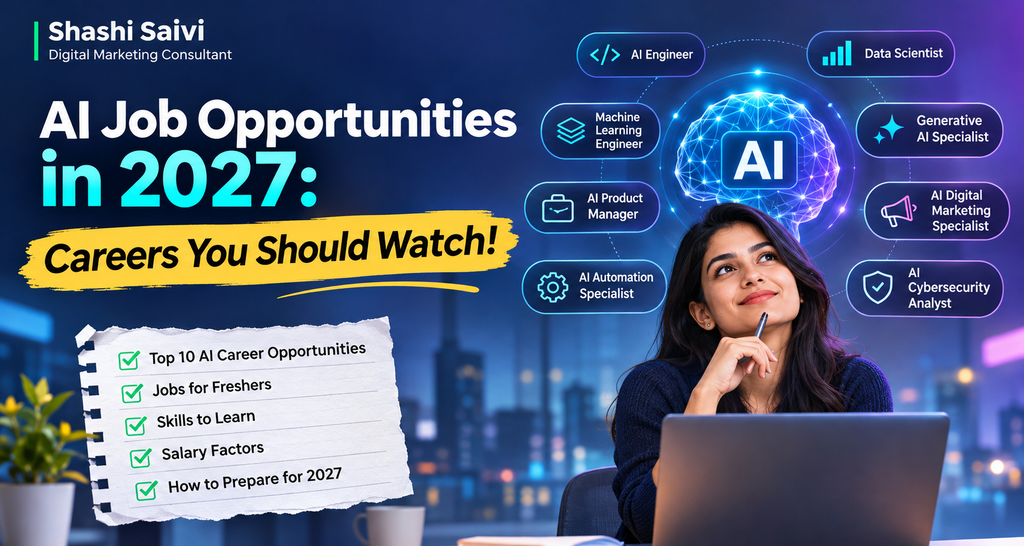
AI Job Opportunities in 2027: Top 10 Careers, Skills & Jobs for Freshers
Artificial Intelligence is no longer just a technology used by big companies or software engineers. It has become part of our everyday lives, changing how businesses operate, how people work and how companies hire employees. From generating content and analysing customer behaviour to developing software and automating business operations, AI is creating new possibilities across almost every industry.
As we move towards 2027, the demand for professionals with artificial intelligence skills is expected to grow further. Companies are increasingly looking for people who understand how to use AI tools, analyse information, build intelligent systems and solve real business problems.
The interesting part is that you do not necessarily need a computer science degree to build a career in artificial intelligence. Opportunities are emerging in marketing, finance, healthcare, education, design, customer service, data analysis and several other fields.
For students, fresh graduates and working professionals, this could be the right time to explore the opportunities emerging in this space.
In this guide, we will explore the most promising AI Job Opportunities in 2027, the skills employers may look for, career options for freshers, expected salary considerations and how you can prepare yourself for the changing job market.
Why Will AI Create More Job Opportunities in 2027?
Artificial intelligence is changing the way organisations manage their operations. Businesses are adopting AI-powered solutions to reduce repetitive work, improve customer experiences, make faster decisions and increase productivity.
For example, an e-commerce company can use AI to understand customer preferences and recommend products. A healthcare organisation can use AI-assisted systems to analyse medical information. Similarly, marketing teams can use AI to understand campaign performance, generate insights and improve advertising strategies.
As companies adopt these technologies, they need professionals who can implement, manage, monitor and improve AI-powered solutions.
According to the World Economic Forum’s Future of Jobs Report 2025, AI and big data are among the fastest-growing skills expected to gain importance between 2025 and 2030. AI and machine learning specialists, big data specialists and software developers are also among the fastest-growing professional roles.
This indicates that AI is not simply changing existing jobs. It is also creating demand for new skills and specialised career paths.
Here are some reasons why AI-related careers could become increasingly important in 2027:
- Business automation: Organisations need professionals who can automate repetitive processes and improve operational efficiency.
- Data-driven decisions: Companies require people who can analyse large volumes of information and convert data into useful business insights.
- Generative AI adoption: Businesses are exploring AI tools for content creation, software development, customer support and research.
- Cybersecurity requirements: As digital systems become more advanced, protecting data and AI infrastructure becomes increasingly important.
- AI-powered products: Companies need professionals who can develop, manage and improve intelligent applications.
- Personalised customer experiences: Businesses are using AI to understand customer behaviour and deliver more relevant experiences.
The result is a changing employment landscape where technical knowledge, business understanding and practical AI skills can create valuable career opportunities.
Top 10 AI Job Opportunities in 2027
If you are planning to build a career in artificial intelligence, it is important to understand which roles are emerging and what professionals actually do in these positions.
Let’s explore ten AI career options worth watching in 2027.
1. Artificial Intelligence Engineer
AI engineers are responsible for developing and implementing intelligent systems that can perform tasks with minimal human intervention.
They work on AI applications, automation systems, machine learning models and intelligent software solutions.
For example, an AI engineer might develop a chatbot for a banking company, an automated recommendation system for an e-commerce platform or an intelligent application that helps businesses process customer information.
Key responsibilities:
- Developing and implementing AI-powered applications.
- Working with machine learning models.
- Integrating AI APIs into software applications.
- Improving the accuracy and performance of AI systems.
- Collaborating with software developers and data teams.
Skills to learn: Python, machine learning, APIs, AI frameworks, mathematics and problem-solving.
Who should consider this career? Students with an interest in programming, mathematics, software development and technology.
2. Machine Learning Engineer
Machine learning engineers build systems that learn from data and improve their performance over time.
Instead of programming every instruction manually, these systems identify patterns in available information and use them to make predictions or recommendations.
For example, streaming platforms use machine learning to recommend movies, while financial organisations use it to identify suspicious transactions.
Key responsibilities:
- Developing machine learning algorithms.
- Preparing and processing datasets.
- Training and testing predictive models.
- Improving model accuracy.
- Deploying machine learning solutions.
Skills to learn: Python, SQL, statistics, TensorFlow, PyTorch and machine learning algorithms.
This is a promising career option for people interested in data science, programming and advanced analytics.
3. Generative AI Specialist
Generative AI has introduced a new category of career opportunities. These professionals work with AI systems that generate text, images, videos, code and other forms of digital content.
Businesses are exploring generative AI to improve productivity, automate workflows and create new digital products.
A Generative AI Specialist may help an organisation implement AI tools, develop customised applications or improve the way employees use generative AI.
Key responsibilities:
- Working with large language models.
- Developing AI-powered content workflows.
- Integrating generative AI APIs.
- Testing and improving AI-generated outputs.
- Building business applications using generative AI.
Skills to learn: Generative AI platforms, Python, API integration, prompt engineering, LLM fundamentals and workflow automation.
This role can be particularly interesting for technology professionals who want to work with emerging AI applications.
4. Prompt Engineer and AI Workflow Specialist
AI tools are powerful, but the quality of their output depends heavily on the instructions, context and information provided to them.
Prompt engineers and AI workflow specialists focus on designing effective instructions and workflows that help AI systems deliver useful results.
However, prompt engineering should not be viewed as simply writing a few instructions into an AI chatbot. Professional opportunities increasingly involve understanding business requirements, testing outputs, integrating tools and building repeatable processes.
Key responsibilities:
- Designing and testing prompts.
- Improving AI-generated responses.
- Creating reusable AI workflows.
- Connecting AI tools with business applications.
- Evaluating output quality and accuracy.
Skills to learn: Prompt design, critical thinking, AI tools, workflow automation, communication and basic technical understanding.
This can be an accessible starting point for professionals from marketing, content, operations and business backgrounds.
5. Data Scientist
Data scientists help businesses understand information and make better decisions.
They collect, organise and analyse data to identify patterns, forecast trends and solve business problems.
For example, a retail company may use data science to predict product demand, while a marketing organisation may analyse customer behaviour to improve campaign performance.
Key responsibilities:
- Collecting and analysing data.
- Creating predictive models.
- Identifying trends and patterns.
- Preparing reports and dashboards.
- Communicating insights to business teams.
Skills to learn: Python, SQL, statistics, Power BI, Tableau, machine learning and data visualisation.
Data science is a strong career option for candidates who enjoy analytical thinking and working with numbers.
6. AI Product Manager
Not every AI-related job requires coding. AI product managers are responsible for understanding business requirements and converting them into AI-powered products or features.
They work with developers, designers, business teams and stakeholders to ensure that AI products solve genuine customer problems.
For example, an AI product manager working with an education company might help develop an intelligent learning platform that recommends study material based on student performance.
Key responsibilities:
- Identifying opportunities for AI-powered products.
- Understanding customer requirements.
- Defining product strategies and roadmaps.
- Coordinating with technical teams.
- Monitoring product performance.
Skills to learn: Product management, AI fundamentals, market research, communication, business strategy and data analysis.
This is a particularly interesting option for experienced professionals from product management, business analysis and technology consulting backgrounds.
7. AI Automation Specialist
Businesses perform thousands of repetitive activities every day. These may include managing customer enquiries, updating spreadsheets, sending notifications, processing information and generating reports.
AI automation specialists help organisations streamline these activities using automation platforms and artificial intelligence.
For example, a company may create an automated system that receives customer enquiries, categorises them, prepares responses and forwards important requests to the appropriate department.
Key responsibilities:
- Identifying repetitive business processes.
- Designing automation workflows.
- Integrating AI with existing applications.
- Testing automated systems.
- Monitoring workflow performance.
Skills to learn: Make, Zapier, n8n, AI APIs, workflow design and basic programming.
This career path can be suitable for people interested in business operations, technology and process improvement.
8. AI Digital Marketing Specialist
Digital marketing is another field where artificial intelligence is creating new career opportunities.
Marketing professionals are already using AI to research audiences, generate content ideas, analyse campaign data, improve customer segmentation and automate marketing processes.
However, successful marketing still requires strategy, creativity, customer understanding and the ability to interpret business results.
An AI Digital Marketing Specialist combines marketing knowledge with AI-powered tools to improve campaign efficiency and performance.
Key responsibilities:
- Using AI for audience and competitor research.
- Supporting SEO and content optimisation.
- Analysing Google Ads and Meta Ads performance.
- Developing automated marketing workflows.
- Improving customer segmentation.
- Using AI-powered analytics to identify growth opportunities.
Skills to learn: Google Ads, Meta Ads, SEO, GA4, marketing automation, generative AI tools, analytics and prompt engineering.
This is one of the most accessible AI career directions for people who already have experience in digital marketing, advertising, content creation or business development.
9. AI Cybersecurity Analyst
As organisations adopt AI-powered applications and digital infrastructure, protecting information becomes increasingly important.
AI cybersecurity analysts help identify potential security threats, investigate suspicious activities and protect organisational systems.
AI-assisted security tools can help analyse large volumes of security information and identify unusual patterns that may require investigation.
Key responsibilities:
- Monitoring security systems.
- Identifying potential cyber threats.
- Investigating suspicious activities.
- Supporting security assessments.
- Evaluating risks associated with AI systems.
Skills to learn: Networking, cybersecurity fundamentals, cloud security, Python, threat detection and security monitoring.
Candidates interested in cybersecurity and information technology can explore this growing specialisation.
10. AI Research Scientist
AI research scientists work on developing new methods, algorithms and technologies that improve artificial intelligence.
Their work may involve researching machine learning techniques, improving language models, developing computer vision systems and exploring advanced AI applications.
Unlike many other AI roles, this career generally requires strong mathematical knowledge and advanced technical education.
Key responsibilities:
- Conducting AI and machine learning research.
- Developing experimental models.
- Evaluating research findings.
- Publishing technical research.
- Improving existing AI methods.
Skills to learn: Advanced mathematics, statistics, Python, deep learning, research methodology and machine learning.
This career is suitable for candidates interested in scientific research, advanced computing and academic or industrial research environments.
AI Job Opportunities in 2027 for Freshers
One of the biggest questions among students and recent graduates is whether they can enter the AI industry without years of professional experience.
The answer is yes, although the right entry-level role will depend on your educational background, practical skills and ability to demonstrate what you can do.
Freshers do not necessarily need to begin as AI engineers. There are several entry points across technology and business functions.
Some entry-level opportunities worth exploring include:
| Job Role | Skills to Focus On |
|---|---|
| Junior AI Developer | Python, APIs, AI fundamentals |
| AI Data Analyst | Excel, SQL, Power BI |
| AI Content Specialist | Writing, research, AI tools |
| Prompt Specialist | Prompt design, critical thinking |
| Junior Automation Executive | n8n, Zapier, workflow design |
| AI Marketing Executive | SEO, Google Ads, AI tools |
| Machine Learning Intern | Python, statistics, ML basics |
| AI Research Assistant | Research, mathematics, data analysis |
How Freshers Can Prepare for AI Careers
If you are starting from zero, avoid trying to learn every AI technology at once.
Instead, follow a structured learning approach.
Step 1: Understand the basics of AI
Learn what artificial intelligence, machine learning, deep learning and generative AI mean. Understand how these technologies are used in real businesses.
Step 2: Select one career direction
Decide whether you are more interested in programming, marketing, analytics, automation, design or business management.
Step 3: Learn relevant AI tools
Choose tools based on your career direction rather than collecting certificates without practical knowledge.
Step 4: Build practical projects
Create something that demonstrates your skills. It could be a chatbot, an automated reporting system, an AI-powered content workflow or a data analysis project.
Step 5: Build your professional portfolio
Show recruiters what you can actually do. Add project descriptions, screenshots, results and links to your work wherever possible.
Step 6: Apply for internships and entry-level positions
Look for opportunities where you can work on real projects and gain practical experience.
A strong portfolio and a clear understanding of your chosen field can make your profile more competitive.
AI Job Opportunities in 2027 Without Coding
Here is some good news for people who are not interested in programming.
You can explore several AI-related careers without becoming a software developer.
Businesses need professionals who understand customers, marketing, operations, communication, content and business strategy. AI tools can support these functions, but human expertise remains important.
Some career options include:
- AI Digital Marketing Executive: Uses AI tools to support advertising, SEO, audience research and campaign optimisation.
- AI Content Strategist: Develops content strategies and uses AI to support research, planning and production.
- AI Business Analyst: Studies business requirements and identifies opportunities for AI implementation.
- AI Automation Consultant: Helps businesses identify and automate repetitive processes using no-code and low-code tools.
- AI Social Media Manager: Uses AI tools for content planning, performance analysis and social media workflows.
- AI Customer Experience Specialist: Helps improve customer interactions using AI-powered support and communication systems.
- AI Project Coordinator: Supports the planning, execution and monitoring of AI-related projects.
Remember that no-code does not mean no skills. These positions still require domain knowledge, analytical thinking, communication and practical experience.
Which Industries Will Offer AI Career Opportunities in 2027?
AI adoption is not limited to technology companies. Different industries are exploring ways to integrate intelligent systems into their operations.
Here are some sectors worth watching.
1. Healthcare
Healthcare organisations are exploring AI applications in medical imaging, patient management, research, administrative workflows and healthcare analytics.
Potential career areas include healthcare data analysis, AI application development and medical technology support.
2. Banking and Finance
Banks and financial institutions use advanced analytics and AI-assisted systems for fraud detection, risk assessment, customer support and financial operations.
Professionals with knowledge of finance, data analytics and AI can explore opportunities in this sector.
3. Education and EdTech
AI is creating opportunities in personalised learning, educational content development, student support and intelligent learning platforms.
Education companies may require AI product specialists, learning experience designers and educational technology professionals.
4. E-commerce and Retail
Online businesses can use AI to improve product recommendations, understand buying behaviour, forecast demand and personalise customer experiences.
This creates opportunities in e-commerce analytics, AI marketing and automation.
5. Digital Marketing and Advertising
Marketing teams are increasingly exploring AI-powered research, campaign analytics, content production and customer segmentation.
Professionals who understand advertising platforms, marketing analytics and AI tools can build valuable career specialisations.
6. Manufacturing and Logistics
Manufacturing companies are exploring predictive maintenance, quality control, supply chain optimisation and intelligent automation.
This creates demand for professionals who understand industrial processes, analytics and automation technologies.
Essential Skills Required for AI Jobs in 2027
Getting an AI-related job is not only about learning how to use ChatGPT or another AI application.
Employers need professionals who can apply technology to solve actual problems.
Here are some important skills worth developing.
1. AI and Machine Learning Fundamentals
Understand how AI systems work, what they can do and where their limitations exist.
2. Data Analysis
Learn to work with information, identify patterns and make data-driven decisions.
3. Programming Knowledge
Python and SQL are particularly useful for technical AI and data-related careers.
4. Generative AI Tools
Develop practical experience with AI assistants, image generation, research tools and large language model applications.
5. Prompt Engineering
Learn how to provide clear instructions, relevant context and structured inputs to AI systems.
6. Automation Skills
Understand how to connect different applications and automate repetitive workflows.
7. Critical Thinking
AI-generated information needs human evaluation. The ability to verify facts and identify errors is essential.
8. Communication and Problem-Solving
Professionals must be able to understand business requirements and explain technical solutions in a simple way.
The World Economic Forum also highlights creative thinking, analytical thinking, resilience and lifelong learning among the skills expected to become increasingly important.
How to Start Preparing for AI Job Opportunities in 2027
If you want to enter the AI industry, you do not have to wait until 2027. You can start preparing now.
Here is a practical six-month roadmap.
Month 1: Learn AI Fundamentals
Understand artificial intelligence, machine learning, generative AI and the difference between automation and intelligent systems.
Explore different AI applications and identify the career direction that interests you.
Month 2: Select Your Specialisation
Choose one area such as AI development, digital marketing, data analytics, automation or product management.
Research job descriptions to understand the skills companies are asking for.
Month 3: Learn Industry-Relevant Tools
Start using tools that match your selected career path.
For example:
- Technical careers: Python, SQL, TensorFlow and PyTorch.
- Marketing careers: ChatGPT, Gemini, GA4 and marketing automation platforms.
- Data careers: Excel, SQL, Power BI and Python.
- Automation careers: n8n, Make and Zapier.
- Product careers: AI product research, analytics and project management tools.
Month 4: Build Real-World Projects
Create at least two or three projects that demonstrate your knowledge.
Avoid creating projects only for the sake of adding them to your resume. Focus on solving actual problems.
Month 5: Improve Your Resume and Portfolio
Highlight your relevant skills, projects, internships and practical experience.
Use measurable outcomes wherever possible. Recruiters should understand what you have created and what problem it solves.
Month 6: Start Applying for Jobs
Explore job openings, connect with industry professionals and apply for internships or full-time positions.
Prepare for interviews by practising practical questions and explaining your projects clearly.
This roadmap is a starting point, not a guarantee of employment. The time required will depend on your existing knowledge and the complexity of your chosen career.
Expected Salary for AI Jobs in India in 2027
Salary is one of the most common factors people consider before choosing a career.
AI professionals may earn competitive salaries, but compensation varies significantly depending on the job role, technical expertise, company, location and experience.
For example, an AI engineer working on production-level applications may have a different compensation structure from an AI content specialist or a junior data analyst.
Rather than relying on unverified salary predictions for 2027, candidates should research current vacancies and salary reports for their specific roles.
Factors that can influence AI salaries include:
- Years of relevant professional experience.
- Knowledge of specialised AI technologies.
- Practical project experience.
- Programming and analytical skills.
- Industry and company size.
- Location and remote working arrangements.
- Ability to demonstrate measurable business results.
For freshers, practical knowledge and relevant internships can help establish a strong starting point. For experienced professionals, combining existing industry expertise with AI skills may create opportunities for career progression.
Will AI Replace Jobs or Create New Career Opportunities?
This is an important question, particularly for people who are concerned about automation.
The reality is that AI will automate certain tasks, change the responsibilities of existing positions and create new opportunities at the same time.
For example, routine content formatting, basic data entry and repetitive reporting can increasingly be supported by automation. However, developing a marketing strategy, understanding customer psychology, managing business relationships and making complex decisions still require human judgement.
The World Economic Forum’s Future of Jobs Report 2025 projects that broader labour-market changes could create 170 million jobs and displace 92 million jobs globally by 2030. These projections cover multiple economic and technological trends, not AI alone.
The important takeaway is that professionals should not focus only on protecting their existing job responsibilities. They should also develop skills that make them more valuable in an AI-enabled workplace.
Instead of competing with AI on repetitive tasks, learn to use it to improve your productivity and decision-making.
Best AI Tools to Learn for Career Growth in 2027
Learning the right tools can help you understand how artificial intelligence is applied in different industries.
Here are some tools worth exploring:
| Tool | Primary Use |
|---|---|
| ChatGPT | Research, writing, analysis and AI assistance |
| Google Gemini | Research and productivity |
| Claude | Writing, reasoning and document analysis |
| Microsoft Copilot | Workplace productivity |
| Midjourney | AI image generation |
| Canva AI | Design and creative workflows |
| GitHub Copilot | AI-assisted coding |
| TensorFlow | Machine learning development |
| PyTorch | Deep learning development |
| Power BI | Data analysis and reporting |
| n8n | Workflow automation |
| Zapier | Application integration and automation |
You do not need to master all these tools. Select the ones relevant to your career goals and focus on practical application.
Final Thoughts: Is 2027 the Right Time to Build a Career in AI?
Artificial intelligence is creating a new landscape for employment, and 2027 could offer interesting opportunities for people who prepare themselves with relevant skills.
Whether you are a college student, a fresher, a working professional or someone planning a career switch, there are multiple ways to enter this growing ecosystem.
You can become an AI engineer, machine learning specialist, data scientist, automation expert, AI product manager or even an AI-powered digital marketing professional.
The most important thing is to understand that learning AI does not mean learning only a collection of tools. It means understanding how technology can solve problems, improve business performance and create better experiences.
My suggestion is simple: choose one career direction, develop the right skills, work on practical projects and keep learning as the technology evolves.
The professionals who understand both their industry and the practical application of AI will be better positioned to take advantage of emerging opportunities.
Your next career opportunity may not require you to compete with artificial intelligence. It may require you to learn how to work with it.
Frequently Asked Questions (FAQs)
1. What are the best AI Job Opportunities in 2027?
Some promising career options include AI Engineer, Machine Learning Engineer, Generative AI Specialist, Data Scientist, AI Product Manager, AI Automation Specialist, AI Digital Marketing Specialist and AI Cybersecurity Analyst.
2. Can freshers get AI jobs in 2027?
Yes. Freshers can explore internships and entry-level opportunities in AI development, data analytics, AI-assisted marketing, automation and content operations. Practical skills and project experience are important.
3. Can I get an AI job without coding?
Yes. Several AI-related careers do not require advanced programming. Examples include AI marketing specialist, AI content strategist, AI business analyst, automation consultant and AI project coordinator.
4. Which AI skills should I learn for 2027?
Start with AI fundamentals, generative AI tools, prompt engineering, data analysis, critical thinking and workflow automation. Learn Python and SQL if you are targeting technical or data-related positions.
5. Is AI a good career option for non-technical students?
Yes. Non-technical students can explore opportunities in AI marketing, business analysis, content strategy, customer experience, product coordination and no-code automation.
6. Which AI jobs are suitable for digital marketing professionals?
Digital marketing professionals can explore AI Digital Marketing Specialist, Marketing Automation Specialist, AI SEO Strategist, AI Content Strategist and Growth Marketing Specialist roles.
7. Will AI replace digital marketing jobs?
AI may automate certain repetitive marketing activities, but marketing strategy, customer understanding, creative direction, campaign management and business decision-making will continue to require human expertise.
8. How can I prepare for an AI career in 2027?
Learn AI fundamentals, select a specialisation, practise industry-relevant tools, create real-world projects, build a portfolio and apply for relevant internships and job opportunities.
9. Do I need a degree in computer science to work in AI?
Not for every AI-related role. Technical positions may require computer science, mathematics or engineering knowledge, while business, marketing, content and automation roles may value relevant industry experience and practical AI skills.
10. Where can I find AI job opportunities in India?
You can explore openings on LinkedIn Jobs, Naukri, Indeed, company career pages and specialised technology recruitment platforms. Search using specific job titles such as AI Engineer, Generative AI Specialist, AI Product Manager and AI Automation Specialist.
About Shashi Saivi
Shashi Saivi is a Digital Marketing Consultant sharing practical insights on digital marketing, career opportunities, emerging technologies, AI, SEO and business growth. The objective is to help students, professionals and business owners understand changing industry trends and make informed career and business decisions.
Stay informed, keep learning and prepare yourself for the future of work.
Phone: +918618112263