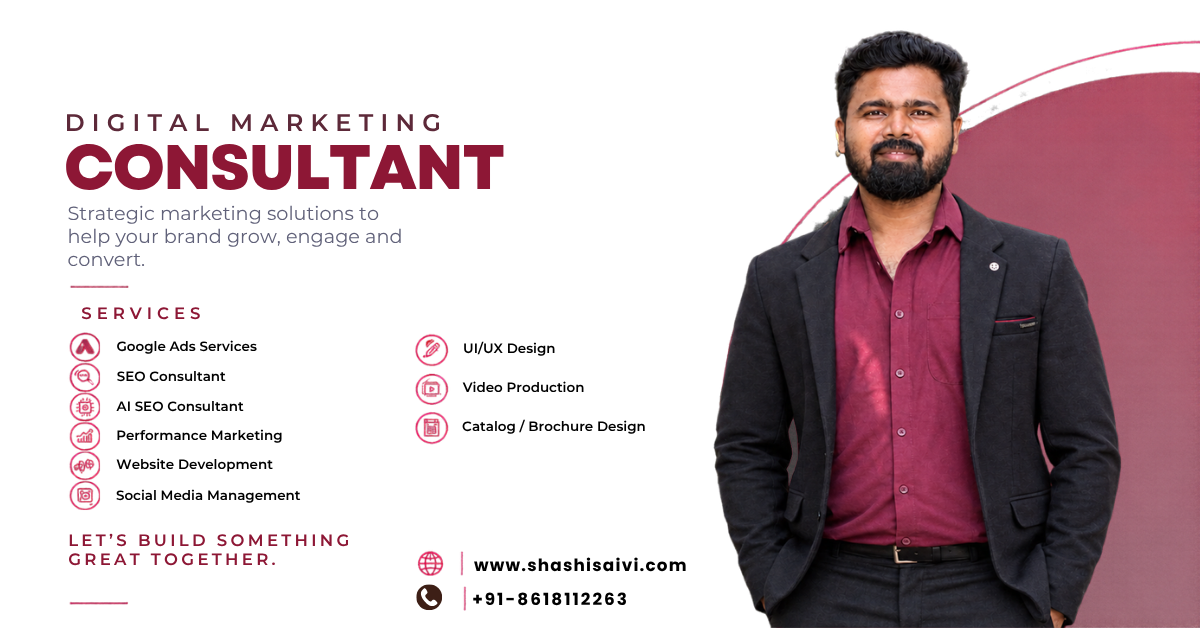
What Does a Digital Marketing Consultant Actually Do?
Many businesses assume a digital marketing consultant simply posts on social media, tweaks Google Ads bids, or sends automated email newsletters.
In reality, a consultant is not just an extra pair of hands for daily execution; they act as a strategic advisor, diagnostic specialist, and growth architect.
While junior marketers focus on activity (publishing blogs, running ads), a digital marketing consultant focuses on commercial outcomes—reducing customer acquisition cost (CAC), optimizing conversion funnels, improving return on ad spend (ROAS), and building scalable acquisition engines.
Here is a look at what a digital marketing consultant does, how they operate, and the real value they bring to a business.
1. Full-Funnel Auditing & Bottleneck Diagnosis
Before recommending a single tactic, a consultant conducts a thorough audit of your digital ecosystem. They analyze where you are losing money, where traffic is dropping off, and why past initiatives underperformed.
A comprehensive audit typically evaluates:
-
Tracking & Attribution: Verifying server-side tracking (Meta CAPI, Google Enhanced Conversions), GA4 event triggers, and CRM data flow to ensure numbers are reliable.
-
Paid Media Health: Identifying wasted budget in Google Ads (e.g., loose broad match queries, unmonitored PMax placements) and Meta Ads (ad fatigue, audience saturation).
-
Organic Footprint: Analyzing technical SEO issues, indexing errors, information gain gaps, and brand authority across search engines.
-
On-Site Conversion Rate (CRO): Reviewing page load speed, mobile layout friction, messaging match, and value propositions across core landing pages.
[Raw Traffic] ──> [Landing Page Experience] ──> [Tracking & Data] ──> [Revenue / LTV]
       ▲                         ▲                       ▲                   ▲
       └─────────────────────────┴───────────┬───────────┴───────────────────┘
                                             │
                               [Consultant Audits & Diagnoses]
2. Designing a Channel-Specific Growth Strategy
Most companies spread themselves too thin trying to be present everywhere: TikTok, LinkedIn, YouTube, SEO, and paid search.
A consultant helps you prioritize channels based on customer intent and unit economics. They build a prioritized roadmap detailing:
-
Where to play: Which 2–3 acquisition channels will deliver the highest ROI for your specific business model (e.g., high-intent Google Search for local services vs. visual Meta/TikTok funnels for D2C).
-
Budget allocation: How much capital should go toward immediate performance media versus long-term brand equity and organic content.
-
Funnel architecture: How top-of-funnel prospects are nurtured into paying customers via email flows, retargeting, and mid-funnel content assets.
3. Optimizing Paid Acquisition & Media Architecture
When businesses manage ad spend internally, campaigns often run on autopilot, burning money on automated defaults. A consultant designs and refines performance campaigns:
-
Structuring campaigns: Splitting brand search from non-brand search, organizing Performance Max into thematic asset groups, and structuring Meta campaigns to give machine learning algorithms clean data signals.
-
Managing unit economics: Setting realistic Target CPA (tCPA) and Target ROAS (tROAS) thresholds so spending scales only when profit margins allow.
-
Creative strategy: Directing video hooks, copy angles, and static assets based on competitive research and past performance metrics.
4. Modernizing SEO & Generative Search Visibility
Search is shifting rapidly toward AI-synthesized summaries (Google AI Overviews, Perplexity, and ChatGPT). A consultant ensures your search strategy keeps up:
-
Answer Engine Optimization (AEO): Restructuring website content with direct answers, clean schema markup, and clear hierarchy to win featured snippets and AI answers.
-
Information Gain: Shifting content production from generic, keyword-stuffed articles to original research, proprietary data, and case studies that AI models cite as source material.
-
Technical Health: Ensuring your site is easily crawlable, mobile-responsive, and unblocked for modern web scrapers.
5. CRO: Fixing the Leaky Bucket
Driving traffic to a poorly designed website is like pouring water into a sieve. A consultant focuses heavily on Conversion Rate Optimization (CRO):
-
Analyzing heatmap and session recordings to see where users get stuck.
-
A/B testing headlines, pricing displays, form fields, and primary calls-to-action (CTAs).
-
Ensuring message match—so the promise made in an ad creative matches the headline the user sees when they land on your website.
6. Marketing Stack & Data Governance
Modern marketing depends on clean technical infrastructure. A consultant advises on and configures your marketing technology (MarTech) stack:
-
Selecting the right CRM (HubSpot, Zoho, Salesforce) and ensuring lead statuses sync back to ad platforms for offline conversion tracking.
-
Building clean dashboards (Looker Studio, PowerBI) so leadership can monitor blended CAC, ROAS, and pipeline velocity without digging through ad accounts.
-
Enforcing privacy compliance, such as Google Consent Mode v2 and cookie policies.
Consultant vs. In-House Marketer vs. Agency
| Role Type | Primary Focus | Best Used For |
| In-House Marketer | Daily execution, brand immersion, internal meetings | Day-to-day social posting, operational support, content writing |
| Marketing Agency | Broad creative execution, production bandwidth | Outsourcing design, video editing, development, and media buying |
| Digital Marketing Consultant | Strategy, diagnostics, systems design, accountability | Fixing declining ROAS, scaling to the next revenue tier, auditing setups |
How Consultants Deliver Their Work
Depending on the agreement, a consultant typically works across one of three frameworks:
-
Strategic Advisory: Bi-weekly or monthly calls where the consultant guides leadership, reviews data, and directs your in-house team or agency on what to execute next.
-
Hands-On Optimization: The consultant builds campaign structures, configures tracking pixels, writes ad copy, and directly manages budgets during a growth or turnaround phase.
-
Fractional Leadership (Fractional CMO): Serving as a part-time marketing executive who manages your team, vendor relationships, and long-term marketing strategy without the cost of a full-time executive hire.
A digital marketing consultant bridges the gap between high-level business goals and ground-level marketing execution. They ensure every rupee or dollar spent on marketing is directly accountable to measurable revenue.
Phone: +918618112263